Choose your line
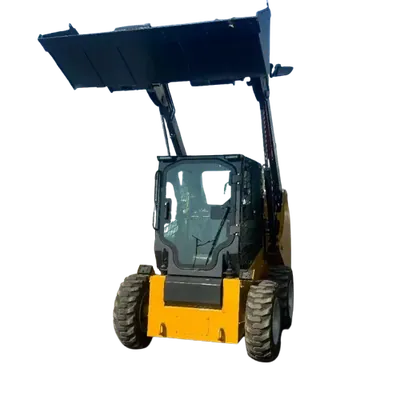
Wheeled Skid Steer Loaders
500 – 1,500 kg rated capacity. Fast, economical and cheap to maintain. Best on hard or paved ground.
View wheeled models →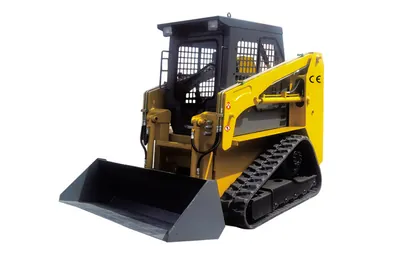
Tracked Skid Steer Loaders
700 – 1,500 kg rated capacity. Low ground pressure and superior traction on soft, wet or uneven ground.
View tracked models →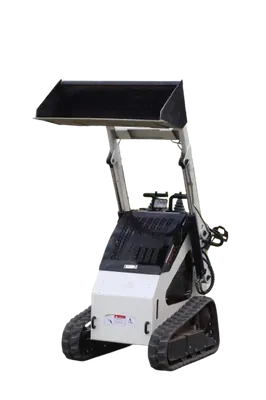
Mini Skid Steer Loaders
300 – 700 kg rated capacity. Compact frames that fit through standard gates and work indoors.
View mini models →Wheel loaders — 1 to 2.8 ton
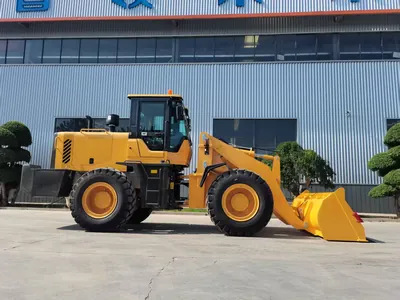
Where the job needs a full-size front-end loader — bulk loading, earthmoving, silo and truck loading — the wheel loader family covers 1 to 2.8 ton with Yunnei, Yuchai and Weichai Deutz engines.
Special-application variants
Besides the three standard lines, the range includes low-profile (D-series) machines for work under low ceilings and obstructions, and remote-controlled (Y-series) machines that keep the operator away from the danger zone. Core figures:
| Model | Series | Rated operating load (kg) | Rated power (kW) | Bucket capacity (m³) | Dead weight (kg) | Max travel speed (km/h) | Overall width (mm) |
|---|---|---|---|---|---|---|---|
| TA35D | Low-profile | 500 | 37 | 0.3 | 2300 | 6 | 1380 |
| TA50D | Low-profile | 750 | 36.8 | 0.4 | 2800 | 6 | 1720 |
| TA35Y | Remote-controlled | 500 | 29.5 | 0.3 | 2300 | 9 | 1350 |
| TA100Y | Remote-controlled | 1200 | 74 | 0.55 | 4500 | 12 / 18 | 1994 |
Tell us your working conditions and we will recommend the right series and configuration.
Wheeled vs tracked: how to decide
| Factor | Wheeled | Tracked |
|---|---|---|
| Purchase price | Lower | 25% – 45% higher |
| Traction on soft ground | Limited | Excellent |
| Ground damage on finished surfaces | Higher | Minimal |
| Travel speed | Faster | Slower |
| Maintenance cost | Lower | Higher (track wear) |
| Best ground condition | Hard / paved | Soft / wet / uneven |
Simple rule: if most of your work is on hard or paved surfaces, buy wheeled. If soft, wet or uneven ground is your primary condition, buy tracked. If you genuinely work both, tracked with careful operation on hard surfaces is usually the more versatile single choice — but two correctly matched machines will always outperform one compromise.
Understanding rated operating capacity
Rated operating capacity (ROC) is the maximum safe load the machine can lift — normally taken at 50% of the machine's tipping load. It is the single most important specification to get right.
To determine what you need:
- Identify your heaviest typical payload (for a full bucket of wet concrete, that is roughly 1,400 kg per cubic metre)
- Add the weight of the attachment itself
- Select a machine whose ROC comfortably exceeds that total
Never specify a machine that only just meets your requirement. Working consistently at maximum capacity accelerates wear and shortens machine life.
Packing a container order? Use the 40HQ loading calculator to estimate how many units fit before you fix the quantity.
Also check dump height and hydraulic flow
- Dump height — must clear your tallest truck bed, hopper or wall by at least 200 mm
- Hydraulic flow — if you plan to run a breaker, cold planer, mulcher or trencher, confirm whether standard or high-flow hydraulics are required. A mismatch means the attachment simply cannot perform
- Quick-attach type — confirm compatibility if you already own attachments
Standard and optional equipment
- Universal quick-attach plate (standard)
- Open ROPS/FOPS canopy or enclosed cab with A/C
- Standard or high-flow auxiliary hydraulics
- Mechanical or joystick (pilot) controls
- Choice of engine brand to match local parts availability
- Custom paint colour and logo for distributors
Replacement parts, not new equipment? Part numbers are quoted from the serial number — see how parts are ordered and quoted.
Not sure which model fits?
Tell us your working conditions, payload requirements and destination port. Our export team will recommend the right configuration and send a full quotation within 24 hours.
Request a Quote →Frequently asked questions
What is rated operating capacity?
About half the tipping load, the load a machine can carry through a full lift and travel cycle without becoming unstable. Published figures assume a standard bucket on level ground.
How do I choose between wheeled and tracked?
Wheeled machines are faster on hard ground and cheaper to run. Tracked machines win on soft or wet ground and damage finished surfaces less, at 25-45% higher purchase price.
Which machine sizes does TANAN build?
Skid steers from 300 kg to 1,500 kg rated operating load, plus wheel loaders from 1 to 2.8 tonnes. Low-profile and remote-controlled variants sit inside those bands.
What else matters besides rated load?
Dump height for truck loading, hydraulic flow for attachments, and overall width for access. A machine that cannot reach the truck body wastes its rated capacity.